How to Create Custom Spells in Oblivion Remastered
Few aspects of The Elder Scrolls IV: Oblivion Remastered capture the game's freedom and creativity as well as spellmaking. It is through this novel feature that one can truly craft their own magical spells, an immensely personal aspect of the game for any mage who'd prefer to mold their skills into one that suits their own playing style. Where other RPGs limit the player to predetermined lists of spells, Oblivion Remastered places you fully in charge, combining effects, duration, and scale to form totally new and tailored magic. But spellmaking, or crafting custom spells in Oblivion Remastered, is not accessible to begin with. To acquire it, the players need to initially access the ability by playing through the game and gaining access to proper amenities. This guide explains exactly how to access spellmaking, where to locate the Altars of Spellmaking, and how to craft some of the quite good custom spells Oblivion has to offer.
Unlocking Spellmaking in Oblivion Remastered
Make Your Own game Server
When the characters initially crawl out of the sewers in Cyrodiil, there are no custom Oblivion spells. To get them, you can either advance in Mages Guild or open the personal Altar in Frostcrag Spire. Both require time and exploration, but both go down a separate route, whether you join the guild or not.
For everyone except the most veteran of players, the Mages Guild will be the clear place to begin. The guild is the focal point for magical activity in Cyrodiil and offers a variety of services, including spell merchants, training, and altars for enchanting. Spellmaking is reserved for veteran members, however, and newcomers must prove themselves before access is allowed.
The Mages Guild Path
To unlock the Altar of Spellmaking through the Mages Guild, you will need to progress to the rank of Apprentice. You begin as an Associate when you first get initiated, and that only allows for half use of guild facilities. Your first real aim is to obtain Recommendations from the administrators in each seven Mages Guild halls there are in Cyrodiil.
All seven of the recommendations have one task with each, ranging from recovering stolen goods to assisting in research or solving local mysteries. Once you've obtained all seven of the recommendations, you can then go to the Arcane University in Imperial City and talk to Raminus Polus, who will promote you to Apprentice. This rank will enable you to go to the Praxographical Center, where there is the official Altar of Spellmaking.
It is here that magic truly begins. With the Altar now open, players can finally start casting their own personal spells, each of which can be tailored by build, skill level, and imagination.
The Frostcrag Spire Shortcut
Should a visit to the Mages Guild just not be your thing, there's a shortcut. Perched on mountains northeast of Bruma is Frostcrag Spire, one of Oblivion Remastered's most renowned player homes. The tower contains a personal Altar of Spellmaking within, but it will be ineffective initially. In order for it to become functional, players must purchase an upgrade item, the Magetallow Candles Box, from Aurelinwae in the Mystic Emporium store in the Imperial City Market District.
After you buy the item, go back to Frostcrag Spire and place it on the altar to activate it. You can then cast custom spells Oblivion Remastered after that without being limited by Mages Guild rank or politics. Frostcrag Spire is also one of the nicer mage dwellings in the game, with enchanting altars, storage, and a view of the north peak of Cyrodiil.
How To Create Personal Spells in Oblivion Remastered
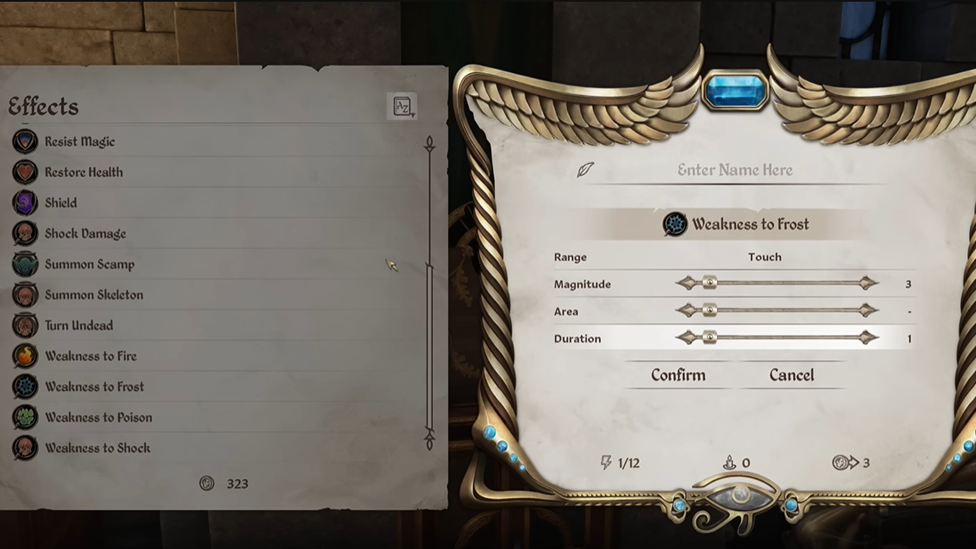
When you can access an Altar of Spellmaking, things become interesting. Talking to the Altar opens up a creation screen, where players can mix and match different effects for spells, change their power levels, and set their parameters.
To put a spell on, you first select an Effect from the left-hand menu. They are limited to effects to be applied for spells you already can perform and cast, based on the level of your magical proficiency. For instance, if your Destruction magic is low, you only get basic elemental effects that you can cast.
The impact of each can then be changed with sliders that adjust Range, Magnitude, Area, and Duration. The higher you have these set, the more potent the spell will be and how far it will go, but also its magicka and gold cost to craft. On the right-hand side of the menu, you will be able to see these numbers shift in real time so that you can compare your spell's potential with your resources.
After finalizing your spell’s attributes, give it a name and select “Create.” The new ability will appear in your magic inventory, ready to cast. From this point forward, it behaves like any other spell, except it’s uniquely yours.
Understanding Spell Balance
It's easy to go overboard when crafting your own spells in Oblivion. Sliders are the art of creating an illusion of boundless power, but creating a spell that sucks all of your magicka out of you when you cast it is unrealistic. The game won't let you create spells that are beyond your ability in one school of magic, but it won't stop you from creating one that you simply can't afford to cast.
Before finalizing a new spell, look up your maximum magicka in the Character screen and compare it to the cost shown in the spellmaking menu. If your magicka pool is lower than the cost, the spell will not be castable without potions or items that boost magicka regeneration. It is prudent to suit your work to your current build, fighting the temptation to employ the truly destructive spells at the beginning of the game when your magic abilities have not yet been enhanced.
Examples of Good Custom Spells in Oblivion
The Fire Damage on Target ability, when applied against Weakness to Fire, can greatly multiply your damage output against monsters by essentially doubling the effect of each subsequent hit. As another example, placing Invisibility in conjunction with Fortify Speed enables players to move quickly past or through guards or opponents unseen.
Explorers like to make it more interesting to produce spells that integrate Water Breathing, Night-Eye, and Detect Life, such that they have total control of dark and underwater spaces. Defensive mages execute layered spells, Summoned Shield, Fortify Health, and Restore Fatigue simultaneously, and they provide great survivability in difficult battles.
It is nearly limitless, and this is the reason Oblivion's personal spells are so enduring and popular among fans.
The Spellmaking Power in Oblivion Remastered
In Oblivion Remastered, the magic system is still one of the largest assets of the game. Crafting spells on your own doesn't only provide you with power; it provides you with independence. If you prefer crafting aggressive offense spells, exploration utility skills, or innovative combinations that turn the game mechanics on their head, the spell-crafting system allows you to do so. It’s also a reflection of how deeply Oblivion values its players. You’re not just learning spells; you’re shaping them, testing them, and evolving them alongside your character’s growth. From humble beginnings as an Apprentice in the Mages Guild to mastering entire schools of magic, the journey of creating custom spells in Oblivion Remastered is one of experimentation and discovery.
Conclusion
The Oblivion custom spell system is one of the building blocks of how magic in the game is so mythical. Either via the Mages Guild Arcane University or by making it available at Frostcrag Spire, the ability to craft your own magic is the cornerstone of the freedom of creativity in Oblivion Remastered.
When you've learned to craft spells and are making your own solid casts, you'll be playing the game in entirely new and different ways. The best of Oblivion's user-customized spells are most likely to be those that you have made yourself, built to suit your imagination, style of play, and objectives as the Hero of Cyrodiil.
So, discover the Altars, experiment with effects, and unleash your brand of magic on Tamriel. In Oblivion Remastered, a mage's might is not in their spells, but in the way they cast them.